
The challenge
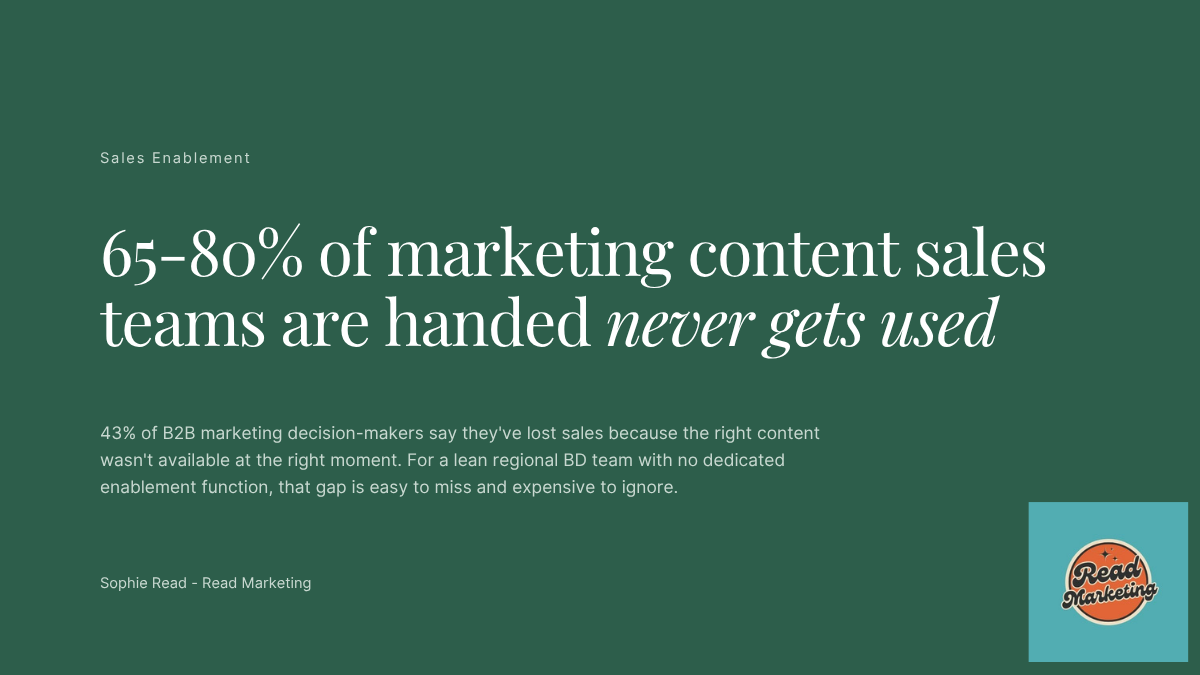
Between 65% and 80% of marketing content produced for a sales team goes unused, and Forrester estimates roughly $2.3 million wasted annually per enterprise on content nobody ever sends. More pointedly, 43% of B2B marketing decision-makers report losing actual sales because the right content wasn’t available at the moment a prospect needed it. Organisations with a genuinely formal sales enablement approach see win rates around 49%, against 42.5% without one. The CRO and lab services piece elsewhere on this blog touched on this lightly. It deserves proper treatment: the content a BD team is handed is often the single most overlooked lever in a regional venture’s whole marketing operation.

01 The deck isn’t the pitch. The conversation is
A sales deck’s real job is to support a conversation, guide discovery, and work as a leave-behind once the meeting ends – not to carry the pitch on its own. That last function matters more than most teams realise: 78% of B2B buyers say they want to self-educate across channels, in their own time, which means whatever gets left behind after a meeting has to work without anyone in the room to explain it. A polished deck that only makes sense with a live presenter attached fails at exactly the moment it’s needed most – when a champion inside the buying company is trying to sell the idea internally, without you.
This matters even more in a sector where the average buying committee runs to eleven or more stakeholders, as covered in the piece on CRO and vendor shortlists. A BD team’s real audience for most materials isn’t the person in the room. It’s the colleagues that person has to convince afterwards.
The reframe
The best sales material isn’t judged by how well it performs live. It’s judged by how well it performs when your champion is presenting it to their own internal committee, with you nowhere in the room.
Why most sales content quietly fails
Current 2026 data on the content-to-sales disconnect
| 65 – 80% Of marketing content handed to sales teams goes unused | 43% Of B2B marketers report lost sales from content unavailable at the right moment |
| 49% vs 42.5% Win rate with a formal enablement approach vs. without one | 23% More competitive deals won by teams using proper battlecards |
Sources: Cirrus Insight, Sales Enablement Statistics 2026, citing Forrester; SiftHub, 70+ Sales Enablement Statistics 2026; Prospeo, Sales Enablement Statistics 2026.
02 What actually belongs in a lean BD team’s toolkit
A small regional team doesn’t need an enterprise content library. It needs a handful of genuinely well-built assets, kept current, mapped to the specific stakeholders in a life sciences buying committee:
- A short, self-explanatory deck built to work as a leave-behind, not just a live presentation aid
- Case studies built around problem, approach, constraints and outcome, cleared for client confidentiality in advance — the same discipline covered in the CRO and vendor shortlist piece
- A one-page technical summary for the specialist evaluator, separate from the higher-level summary built for a budget-holder
- A simple battlecard covering the two or three most common objections and how to answer them, so every conversation doesn’t start from scratch
- Named, dated proof points — funding, awards, published results — kept current on a review schedule, not written once and left to date
A regional BD team doesn’t lose deals because the science isn’t good enough. It loses deals because the material handed over after a great conversation wasn’t good enough to survive being forwarded internally.
03 Why this is a genuine gap for regional CRO and service businesses specifically
🔬
Where this connects directly to earlier work
A lab services or CRO-style business like Biophys Ltd, or a specialist recruiter like CY Partners, lives and dies on exactly the kind of multi-stakeholder buying process this piece describes – a shortlist of four or five vendors, an RFP, and a handful of internal champions doing the selling once the sales team has left the room. Sales enablement material built specifically for that reality is a genuinely different asset from a generic capabilities brochure.
Source: general observation of regional CRO and service provider sales cycles.
Getting this right is exactly the sector-specific, regionally-literate work that generic sales enablement advice misses – understanding both the genuinely long, multi-stakeholder buying process in this sector and the specific materials that survive being forwarded without a salesperson attached. A biotech, med-tech or CRO-style business in Newcastle, Durham, Edinburgh or Glasgow deserves a BD toolkit built for how its buyers actually decide, not a generic deck template with the logo swapped out.
Would your sales deck survive being forwarded without you in the room?
Read Marketing works with biotech, med-tech and lab services businesses across the North East and Scotland to build sales enablement material that actually gets used, and actually gets forwarded.
Leave a Reply