
The challenge
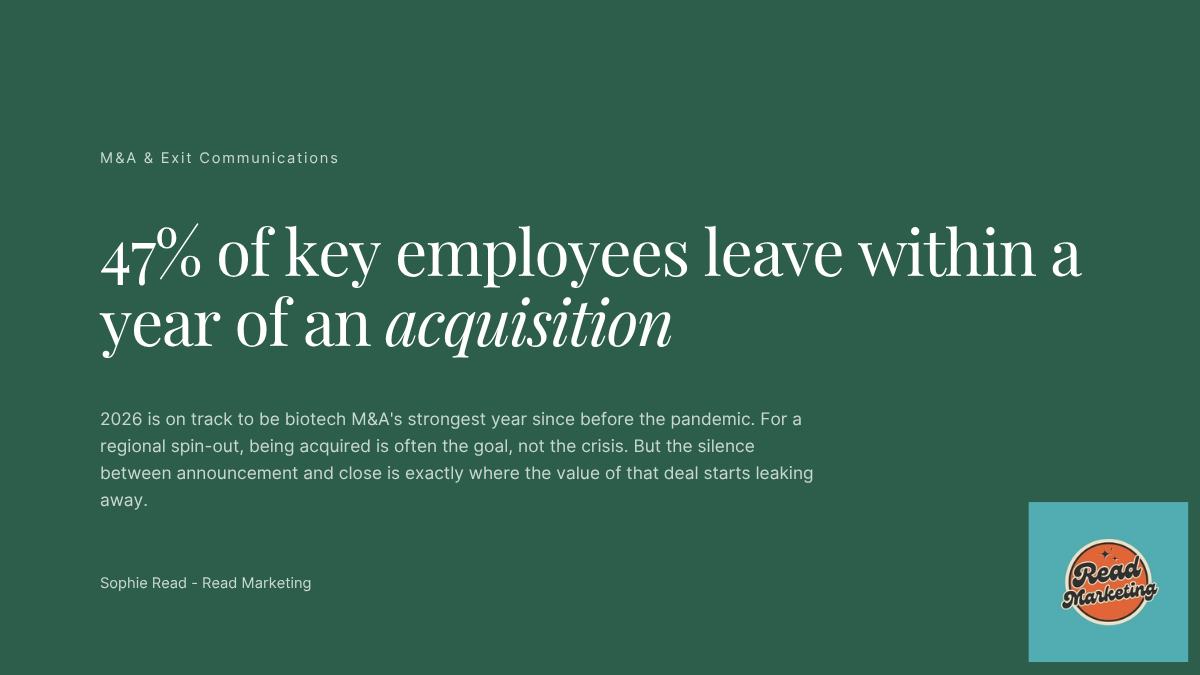
Biotech M&A hit $106 billion across 201 transactions by mid-2026, on track to be the strongest year for deal-making since before the pandemic, with average deal value climbing to $527 million. Being acquired is, for many regional spin-outs, the successful outcome the whole funding journey was built toward – not a crisis to manage. But the people side of that success is genuinely fragile: 47% of key employees typically leave within a year of an acquisition, rising to 75% within three, and acquired staff attrition runs roughly two to three times higher than normal turnover. The single biggest predictor of which outcome a company gets isn’t the deal terms. It’s the communication in the gap between announcement and close.

01 Silence is where the damage actually starts
The most common failure across every stage of an acquisition is silence between the announcement and the deal closing. That gap is where attrition begins, because in the absence of real information, people write their own story – and 61% of employees who consider leaving a role cite poor internal communication as a contributing factor. Employees start making exit decisions before leadership has finished making retention decisions, simply because nobody told them anything in the meantime.
This isn’t unique to large corporate mergers. A twelve-person spin-out being acquired by a larger biotech or pharma company faces exactly the same dynamic, just with fewer people to absorb the loss if a key scientist walks – and a founding researcher’s departure can take irreplaceable institutional knowledge with them at exactly the moment the acquirer most needs it to stay.
The reframe
An acquisition announcement isn’t the end of the communications job. It’s the start of the period where communication matters most, and where most companies quietly stop doing it well.
What’s actually at stake in the gap between announcement and close
Current 2026 data on M&A attrition and the deal environment
| $106bn Biotech M&A value by mid-2026, on track for the strongest year since pre-Covid | 47% / 75% Of key employees leaving within one year / three years of an acquisition |
| 34% vs 12% First-year attrition for acquired employees vs. normally hired employees | 61% Of employees considering leaving cite poor internal communication as a factor |
Sources: CNBC/PitchBook, Biotech M&A 2026 tracking; Financier Worldwide, M&A Challenges: Employee Engagement and Retention; MASience, Effective M&A Communication Strategies.
02 The phrases that quietly cause the most damage
Certain phrases feel reassuring to say and consistently set expectations the integration rarely meets. Once employees notice the gap between the phrase and reality, credibility for every future message erodes with it:
X “This is a merger of equals” implies shared control that almost never materialises; the acquiring company nearly always leads
X “Business will continue as usual” rarely true, and noticeably false the moment the first process changes
X “We don’t anticipate making any changes” changes are effectively inevitable in any integration
X “We have similar company cultures” cultural mismatch causes roughly 30% of retention failures; claiming similarity papers over exactly the tension that needs addressing directly
Honest uncertainty communicated clearly “we don’t have an answer to that yet, and we’ll tell you as soon as we do” consistently outperforms a confident-sounding promise that turns out not to hold.
A confident answer that turns out to be wrong costs more trust than an honest “we don’t know yet” ever will. Employees forgive uncertainty. They don’t forgive being misled.
03 Different audiences need genuinely different messages
A complete communications plan covers employees, customers, partners, vendors, investors and press – and each needs a message built around what the deal actually means for them, not a single press release repurposed for everyone. The rebranding piece elsewhere on this blog covers what happens to a company’s name and identity after an acquisition; this is about what gets said, to whom, in the weeks before that happens.
- Employees need clarity on job security, reporting lines and total reward, communicated repeatedly through multiple channels, not a single town hall
- Investors need the strategic rationale and, where relevant, the path to their own return, communicated with the same rigour as any other funding update
- Customers and partners need direct reassurance that existing commitments and relationships will be honoured, ideally from a named contact they already trust
- Press and trade media need a clear, accurate story before rumour fills the gap - exactly the earned-media discipline covered in the piece on PR and trade press relations
🌊
Why this matters for a regional spin-out specifically
Companies moving through Northern Accelerator, Converge or the Inspire Fund are, in many cases, explicitly building toward an eventual acquisition as the funding journey’s successful conclusion. A well-communicated exit protects the founders’ and investors’ return, the acquiring company’s investment, and the reputation of the whole regional ecosystem the next spin-out will be judged against.
Source: general observation of regional spin-out funding trajectories.
Getting this right is exactly the sector-specific, regionally-literate work that generic M&A communications advice misses — understanding both the genuine excitement an acquisition represents for a regional spin-out and the very real attrition risk that excitement can mask if communication goes quiet in the weeks that matter most. A biotech or medtech venture in Newcastle, Durham, Edinburgh or Glasgow deserves an exit communications plan built before the deal is announced, not improvised the week it is.
If your acquisition closed tomorrow, would your team have heard from you today?
Read Marketing works with biotech, med-tech and medical device ventures across the North East and Scotland to plan M&A and exit communications that protect the value of the deal, not just announce it.
Leave a Reply