
The challenge
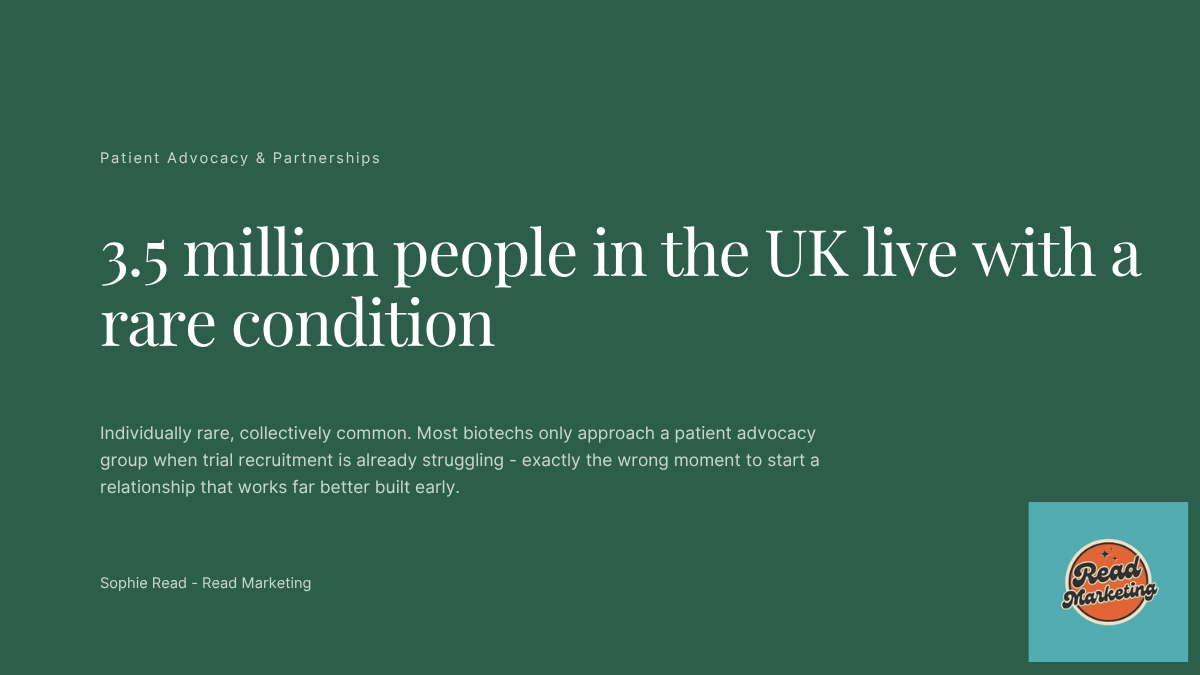
Genetic Alliance UK, an alliance of over 220 charities and support groups, represents a community of some 3.5 million people across the UK living with a genetic, rare or undiagnosed condition – individually rare, collectively common. Yet industry practice still lags behind the science it depends on: too often, companies turn to patient advocacy groups as a last resort when trial recruitment falters, rather than approaching them as partners from the earliest study concept stage. That single sequencing error – approaching a PAG in crisis rather than in planning – is the difference between a transactional ask and a genuine relationship.

01 Why “last resort” engagement fails on its own terms
Patient advocacy groups in the rare disease space are, by industry’s own description, extremely savvy about how drug development actually works – some run their own medical advisory boards, fund research directly, and maintain patient registries and biobanks that generate genuine real-world evidence. One documented case saw an emerging biotech use real-world data gathered through a patient-consented registry to support an IND filing, and the FDA lifted an initial clinical hold on the strength of it. That’s not a goodwill gesture. It’s a PAG functioning as a genuine scientific partner.
A company that only appears once recruitment is struggling is asking a sophisticated, resource-constrained organisation to solve a problem it had no hand in shaping, on a timeline it didn’t help set. Unsurprisingly, that ask lands very differently to one built on a relationship that started months or years earlier.
The reframe
A patient advocacy group approached early can shape trial design around what actually matters to patients — daily logistics, family coordination, realistic burden of participation. Approached late, the same group can only help you recruit for a design that may already have missed those realities.
The scale and shape of the UK’s patient advocacy ecosystem
Why these organisations are genuine partners, not just goodwill recipients
| 3.5m People in the UK living with a rare or genetic condition | 220+ Member charities and support groups within Genetic Alliance UK alone |
| 52% Of rare disease patient advocacy groups receive some corporate or industry funding | 47% Of patient advocacy groups run with no paid staff at all – funding support genuinely matters |
Sources: Genetic Alliance UK, Equity for Rare (2026); PMC, Emerging Roles and Opportunities for Rare Disease Patient Advocacy Groups (2026 survey data); Parexel, Engaging with Patient Advocacy Groups.
02 What genuine partnership actually looks like
The most consistent, well-evidenced guidance across the sector comes down to a handful of disciplined habits, not a single clever tactic:
- Open communication established from the outset, with regular updates rather than contact only when something is needed
- Genuine early involvement in study concept and trial design, not consultation after the design is already fixed
- Identified shared objectives – better outcomes, improved trial accessibility – framed as mutual benefit rather than a favour
- Real resource support: funding, educational materials, logistical help, matched to what most PAGs, running on donations and volunteer time, genuinely need
- Respect for the organisation’s independence – a long-term relationship built on mutual trust, not a transactional ask dressed up as partnership
A patient advocacy group can tell the difference between a company that wants their community’s trust and one that wants their mailing list. The difference shows up in how early you called, not what you said when you did.
03 This is already live in the region’s own policy conversation
🏴
Scotland: a real, recent, named event
On 19 February 2026, Rare Disease Day was marked at Holyrood with MSPs Bob Doris and Jenni Minto – Scotland’s Minister for Health – speaking alongside rare disease charities, clinicians and patients about NHS Scotland’s commitment to improving the diagnostic journey. Genetic Alliance UK’s “Future for Rare” campaign is actively gathering evidence now, ahead of a September 2026 national summit, to shape the policy that replaces the UK Rare Diseases Framework when it concludes in January 2027. A regional biotech with a genuine rare disease angle has a real, current, open door into this conversation, not a hypothetical one.
Source: SMA UK, Rare Diseases Collaborations; Genetic Alliance UK, Future for Rare campaign.
For a company like Nevrargenics, working in neurodegenerative disease, or any regional venture whose research touches a genetically defined or rare condition, this isn’t a marketing opportunity bolted onto the science it’s the same patient community the science exists to serve, already organised, already engaged with government, and already looking for genuine industry partners rather than late-stage recruitment asks.
Getting this right is exactly the sector-specific, regionally-literate work that generic patient engagement advice misses – understanding both the real UK rare disease policy landscape and the genuine, mutual-benefit relationship a patient advocacy group is looking for. A biotech or med-tech venture in Newcastle, Durham, Edinburgh or Glasgow deserves a patient partnership strategy built on the same rigour as the rest of its regulatory and communications work, not an afterthought reached for only when recruitment stalls.
Have you built a relationship with your patient community, or just an ask?
Read Marketing works with biotech, medtech and medical device ventures across the North East and Scotland to build genuine, early patient advocacy partnerships, not last-resort recruitment appeals.
Leave a Reply