
The challenge
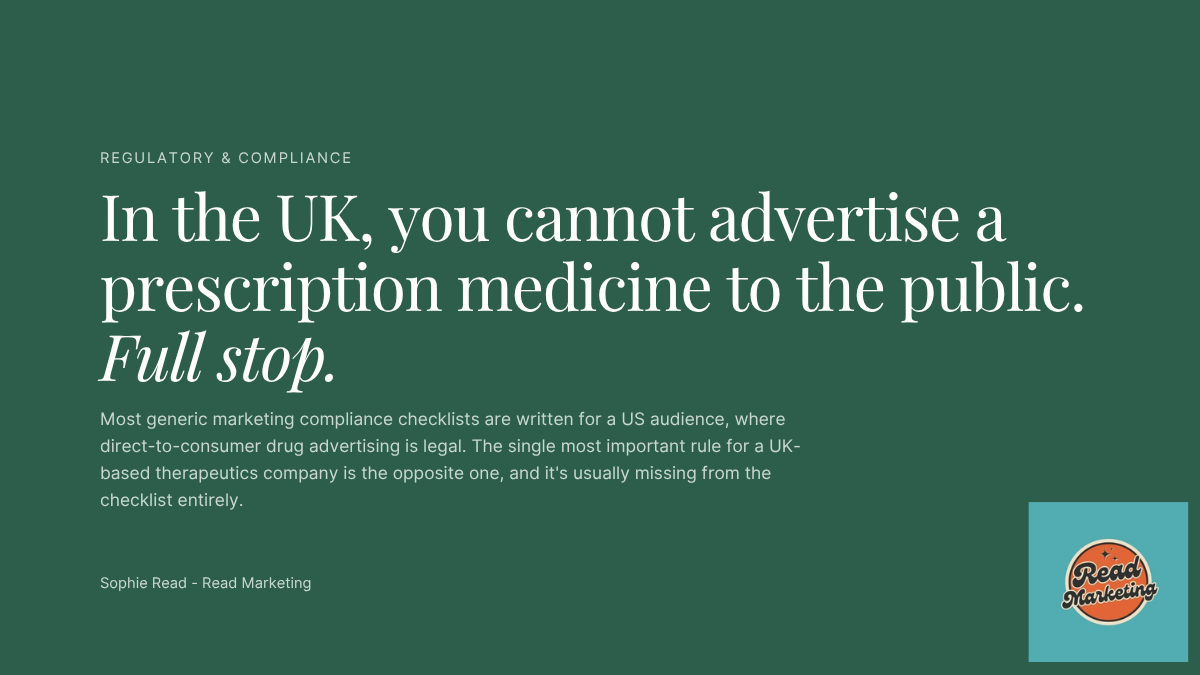
UK law prohibits advertising a prescription-only medicine (POM) directly to the public, full stop a fundamentally different starting position to the US, where direct-to-consumer prescription drug advertising has been legal and commonplace for decades. Generic marketing compliance guidance, often written with an American audience in mind, tends to reference bodies like the FTC that have no jurisdiction here, and misses this single most consequential rule entirely. For a North East or Scottish therapeutics company building toward commercialisation, that’s not a small gap. It’s the rule that shapes almost every other marketing decision that follows.
This is general information, not regulatory or legal advice. The ABPI Code and MHRA advertising regulations are detailed and case-specific. Any company marketing a medicine or medical device in the UK should seek advice from a qualified regulatory affairs professional or lawyer before publishing promotional content.

01 – The framework that actually governs this in the UK
The Association of the British Pharmaceutical Industry (ABPI) Code of Practice, which came into full force on 1 January 2025, governs the promotion of prescription-only medicines to healthcare professionals in the UK, alongside the provision of information to patients and the public. It’s administered independently by the Prescription Medicines Code of Practice Authority (PMCPA), a body established by the ABPI in 1993 specifically to sit at arm’s length from the trade association it polices.
The Code binds every ABPI member company as a condition of membership, and more than sixty non-member companies have voluntarily agreed to be bound by it too meaning it’s accepted by virtually every pharmaceutical company operating in the UK, whether or not they’re formally part of the association.
The reframe
A US-style compliance checklist treats advertising rules as one line item among many. In the UK, the ban on promoting a prescription medicine to the public isn’t a line item – it’s the boundary every other piece of marketing content has to be designed around.
The UK pharma marketing framework, in numbers
What actually applies, and what it costs to get wrong
| 1 Jan 2025 Current ABPI Code came into full force | 60+ Non-member companies voluntarily bound by the Code |
| £5,000 – £14,000 Administrative charge range for a breach, members vs. non-members | 1 Named senior person required at each company to own Code compliance |
Sources: PMCPA, The Code; Legal 500, United Kingdom Pharmaceutical Advertising guide (2026); ICLG, Pharmaceutical Advertising Laws and Regulations Report 2025-2026.
02 – Where this actually bites: social media and websites
The PMCPA’s own social media guidance is blunt: promoting a prescription-only medicine on social media is likely to be problematic, because the underlying legislation only permits POM advertising on websites “whose nature and content are directed at healthcare professionals,” and those sections should ideally be access-restricted. A public LinkedIn post or an open web page describing a specific medicine’s benefits can cross a line that a comparable US company would never encounter.
This is precisely why the distinction between disease-awareness content and product-specific promotion matters so much in UK life sciences marketing. Educating the public about a condition is generally fine. Naming and promoting the specific medicine that treats it, to that same public audience, generally isn’t and the line between the two needs deliberate care, not an assumption that enthusiasm about the science is automatically safe to publish.
Enthusiasm about your own science is exactly the instinct that needs the most regulatory discipline in this sector, not the least.
03 – What this means for a therapeutics-stage regional spin-out
🔬
Building compliance in before commercial pressure arrives
A North East or Scottish spin-out developing a therapeutic candidate, moving through Northern Accelerator or Converge toward first funding, is exactly the kind of company that benefits from understanding this framework early, well before commercial launch makes it urgent. Academic founders are typically well versed in scientific and clinical regulation; the ABPI Code and PMCPA’s specific marketing rules are a different, less familiar layer that deserves the same rigour.
Source: general observation of academic spin-out founding teams; PMCPA guidance for the pharmaceutical industry.
- Understand the distinction between disease-awareness content and product-specific promotion before publishing either
- Name one senior person accountable for regulatory-compliant marketing, as the Code expects
- Treat social media promotion of a specific medicine as high-risk by default, not low-risk because it’s “just LinkedIn”
- Get qualified regulatory advice before a launch campaign, not after a complaint
Getting this right is exactly the sector-specific, regionally-literate work that generic, US-oriented compliance checklists miss-understanding the actual UK framework governing what a therapeutics company can and can’t say to the public. A biotech venture in Newcastle, Durham, Edinburgh or Glasgow deserves marketing built around this framework from the outset, alongside proper regulatory advice, not a checklist imported from a market with different rules.
Is your marketing built for the UK’s actual rules, or a US checklist?
Read Marketing works with biotech, medtech and medical device ventures across the North East and Scotland to build marketing that respects the UK’s specific regulatory framework, alongside qualified regulatory advice.
Leave a Reply