
The idea
STEM – science, technology, engineering, mathematics – has done a great deal of work explaining what young people could become. The case for adding an A, for Arts, is simpler than it sounds: creative thinking isn’t decoration bolted onto scientific rigour. It’s part of how genuine breakthroughs actually happen, and it’s certainly part of how they get explained to anyone outside the lab. For a North East or Scottish life sciences venture, that’s not an abstract argument. It’s the exact translation work between real science and a real audience that this blog keeps coming back to.

01 – The history is longer than the acronym
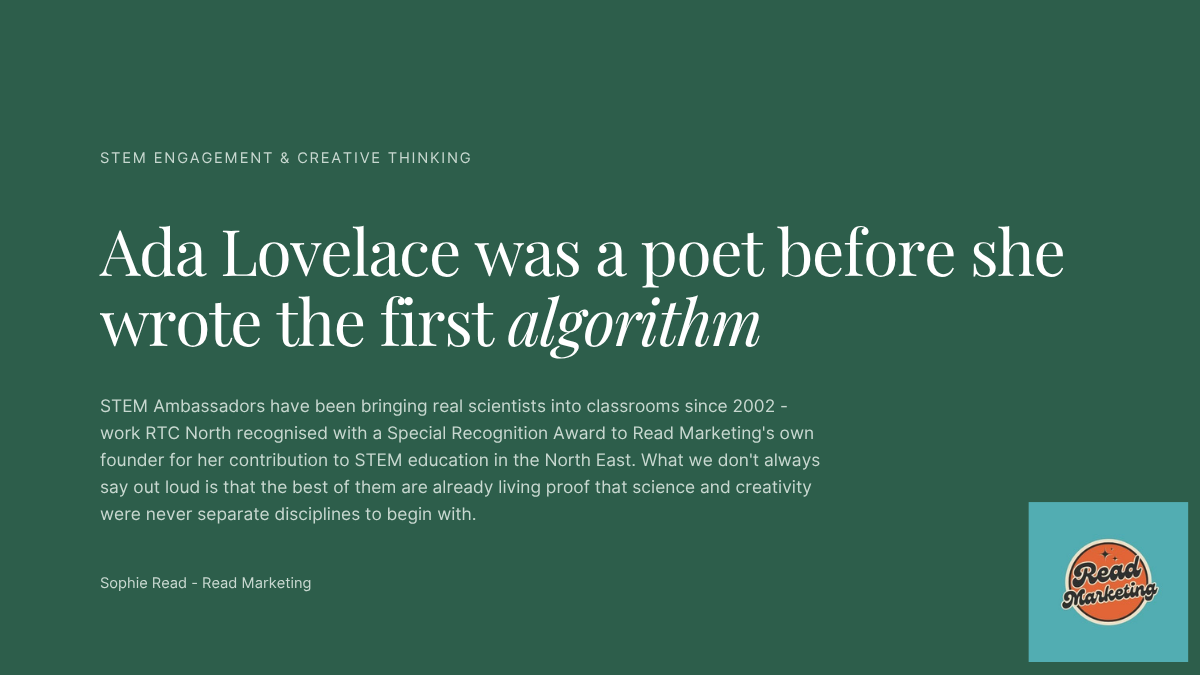
Leonardo da Vinci studied human anatomy with a painter’s eye and designed flying machines with an engineer’s precision, because for him those were never two different ways of looking at the world. Ada Lovelace, working on Charles Babbage’s Analytical Engine, brought a poet’s intuition to what she recognised as the creative potential of early computing, long before anyone else saw computation as anything more than arithmetic. Neither of them treated imagination and rigour as opposites. Each used one to make the other possible.
The STEM Ambassador network, running since 2002 and reaching millions of young people across the UK, already reflects this without always naming it – its volunteers span zoologists, engineers, set designers and climate scientists, brought in precisely because a single, narrow idea of “a scientist” was never accurate to begin with.
The reframe
Adding the Arts to STEM isn’t softening science for a general audience. It’s acknowledging that the clearest scientific thinking has always drawn on the same imagination, storytelling and visual sense that the arts are built from.
STEM engagement, in numbers
The scale of the network bringing real scientists into classrooms across the UK
2002Year the UK-wide STEM Ambassador programme began
| 2002 Year the UK-wide STEM Ambassador programme began | Millions Of young people engaged by STEM Ambassadors to date |
| 200+ STEAM Ambassadors in just one regional hub programme, alongside 76 employer partners | 200+ STEAM Ambassadors in just one regional hub programme, alongside 76 employer partners |
Sources: STEM Learning, STEM Ambassador programme (2026); The STEM Hub; Camden STEAM programme.
02 – The region’s own scientists are already living this
The founders behind Newcastle’s 42 active spin-outs, or Nevrargenics’ Bionow Award-winning work on neurodegenerative disease, are proof enough that world-class science and genuine storytelling instinct aren’t separate skill sets waiting to be reconciled. The translation work this blog keeps returning to helping a scientist-founder explain their work clearly, without losing what makes it rigorous – is creative work in the fullest sense. It just doesn’t always get called that.
It’s the same work recognised by RTC North’s North East STEM Awards, which gave a Special Recognition Award for outstanding contribution to STEM education in the region to Read Marketing’s own founder, Sophie Read – for exactly this kind of translation, done in classrooms rather than boardrooms, over years of volunteering as a STEM Ambassador.
Sophie Read, Founder of Read Marketing & Award-Winning STEM Ambassador
“Every scientist I’ve worked with as a STEM Ambassador has had a story in them long before they had a pitch deck. My job, in both roles, is really the same one: helping brilliant, precise thinking find a shape that someone outside the lab can actually hold onto.”
03 – What STEAM thinking actually changes in practice
None of this requires a scientist to become a designer, or a marketer to become a scientist. It requires treating the translation between the two as genuine creative work, worth the same care as the research itself:
- Visual storytelling and data visualisation, treated as part of communicating the science, not decoration added afterwards
- Named scientists and founders given room to explain their own thinking, not filtered into generic corporate language
- Complex findings translated for a non-specialist audience without being oversimplified or misrepresented
- Creative and scientific input sitting in the same room from the start of a project, not handed off in sequence
A biotech or med-tech venture doesn’t need to choose between being taken seriously as a scientific organisation and communicating with real creativity. The two have never actually been in tension – they just don’t always get treated as part of the same job.
Is your science being explained with the same imagination it took to discover it?
Read Marketing works with biotech, med-tech and medical device ventures across the North East and Scotland to bring genuine creative thinking to real science, without losing the rigour that makes it credible.
Leave a Reply