
The challenge
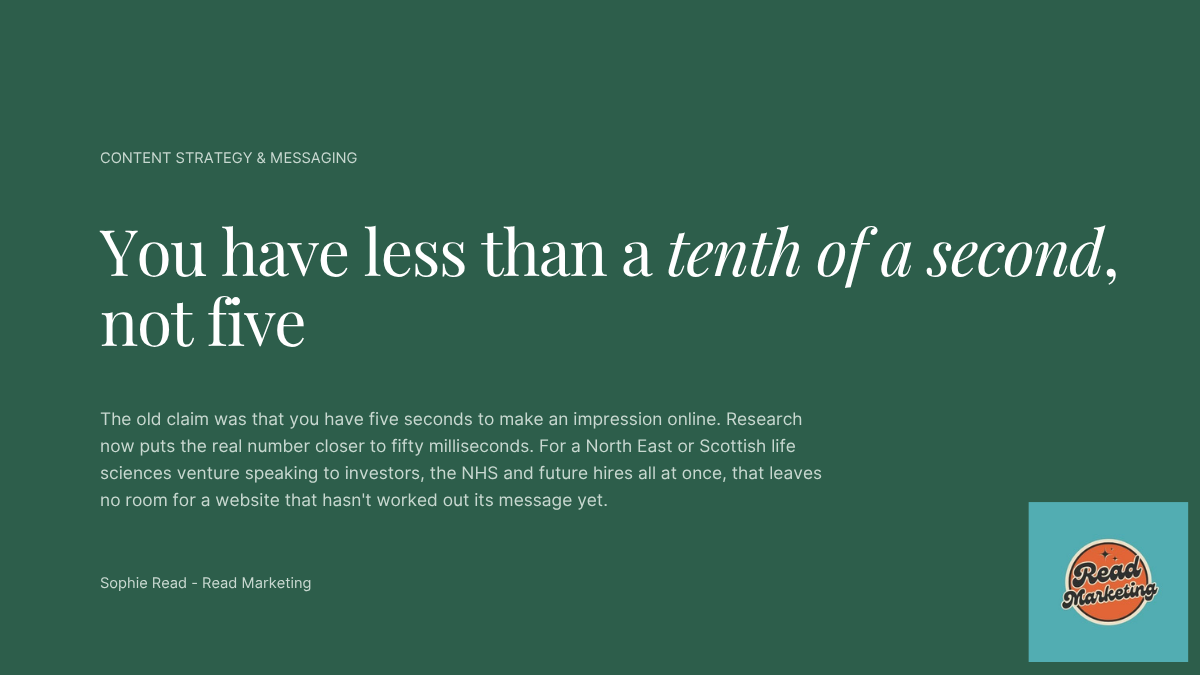
Widely cited research on web credibility puts the time it takes a visitor to form an opinion of a website at around fifty milliseconds a twentieth of a second, and 94% of that snap judgement is design, not words. Stanford’s web credibility research separately found that 75% of people judge an organisation’s credibility from its website design alone. None of that time budget is spent reading your mission statement. It’s spent absorbing an impression, and if that impression doesn’t match what a North East or Scottish life sciences venture is actually offering, the words further down the page rarely get read at all. Messaging — the underlying impression your content is built to create has to be right before a single sentence of copy gets written.

01 – Messaging isn’t content, and it isn’t your mission statement either
Ask a founder if their business has clear messaging and most say yes, then describe their mission statement. The two aren’t the same thing. A mission statement says why the organisation exists. Brand values say what it believes in. Messaging is the subtext underneath all of it the specific, consistent impression a visitor takes away, filtered through what actually matters to them rather than what matters to you.
Good messaging takes your mission and values and runs them through a customer filter: their pain points, their emotions, their decision-making process. Skip that filter and you get a website that’s technically accurate and commercially silent full of content, empty of a reason for anyone to act on it.
The reframe
Messaging comes before content and design in a website project, not after. Without it, content has no throughline and design has nothing to reinforce. Get the message right first, and the content brief and the visual direction both become far easier decisions.
02 – One website, several audiences who need different things from the same message
Most life sciences ventures underestimate how many distinct audiences their website has to satisfy at once, and the North East and Scotland make that especially visible because so much of the region’s support infrastructure is organised by audience type. An investor reading about a spin-out wants to see a route to Northstar Ventures, the North East Spinout Inspire Fund, or Scottish Enterprise’s High Growth SpinOut Programme. An NHS innovation lead wants evidence you understand procurement and the region’s Health Innovation Networks. A prospective hire wants to see a genuine, differentiated place to build a career, not stock imagery of a generic lab.
Each of those readers has a different pain point and a different reason to keep reading, but they’re all looking at the same homepage. Strategic messaging has to hold together across all of them at once, or the site quietly fails whichever audience wasn’t in the room when it was written.
“Messaging is essential for everything from internal business communications to external customer-facing content. Without it, companies risk creating internal chaos and external mistrust.”

What the research actually says about first impressions
Correcting a commonly repeated claim with the current evidence
| 0.05s Time for a visitor to form an opinion of a website (Lindgaard et al.) | 94% Of that first impression is design, not written content |
| 75% Of visitors judge credibility from website design alone (Stanford) | 54s Average time a visitor then spends on a single page, if the impression works |
Sources: Lindgaard et al., web credibility research (widely cited); Stanford Guidelines for Web Credibility; Forbes Advisor, Website Statistics 2025.
03 – The five questions that surface your actual message
Stripped of jargon, strong messaging answers five questions, from the perspective of the person reading, not the person writing:
- What does your business actually do – in one sentence, without the scientific terminology?
- Who are you offering it to, specifically, not “the life sciences industry” in general?
- What’s the benefit to them, addressing the pain point they actually have?
- What do you believe in or stand for as a company, beyond the science itself?
- What genuinely sets you apart from the alternative they’d otherwise choose?
Try answering all five without scientific jargon, in a conversational tone, and most founders find it harder than expected. That difficulty is the signal the messaging work hasn’t been done yet not a sign the business lacks a story worth telling.


04 – Where messaging fits in a website project
After the mission statement, corporate vision and brand values are settled, messaging is the first strategic stage of a website project and, in practice, the last thing checked before launch, because everything else has to be tested against it. Content is built to deliver the message. Design exists to reinforce it visually, in a way that’s easy to absorb in the fraction of a second a visitor actually gives it.
Skip this stage and you get exactly the website most visitors have learned to distrust: modern, well-designed, professionally photographed, and still leaving the visitor unsure what the company actually does or why it matters to them. That failure isn’t a content problem or a design problem. It’s a missing message.
05 – Why regional, sector-specific messaging beats a generic template
A generic messaging workshop produces a generic message. A North East or Scottish life sciences venture needs messaging built by people who already understand the specific funds, NHS structures and university relationships their audiences recognise – so the message can name them directly, rather than gesturing at “innovation” and “excellence” in the abstract.
“Succinct, carefully composed, consistent messaging across all of your communications is a superpower for business growth. Without it, nothing else on the website makes sense.”
Getting this right is exactly the sector-specific, regionally-literate work that generic web design agencies routinely miss. A biotech or medtech venture in Newcastle, Durham, Edinburgh or Glasgow deserves messaging built by people who understand both the science and the specific audiences funding, regulating and hiring into it not a template messaging framework built for life sciences companies in general.
Does your website say what you actually mean?
Read Marketing works with biotech, medtech and medical device ventures across the North East and Scotland to build messaging that holds up to investors, the NHS and future hires alike.
Leave a Reply