
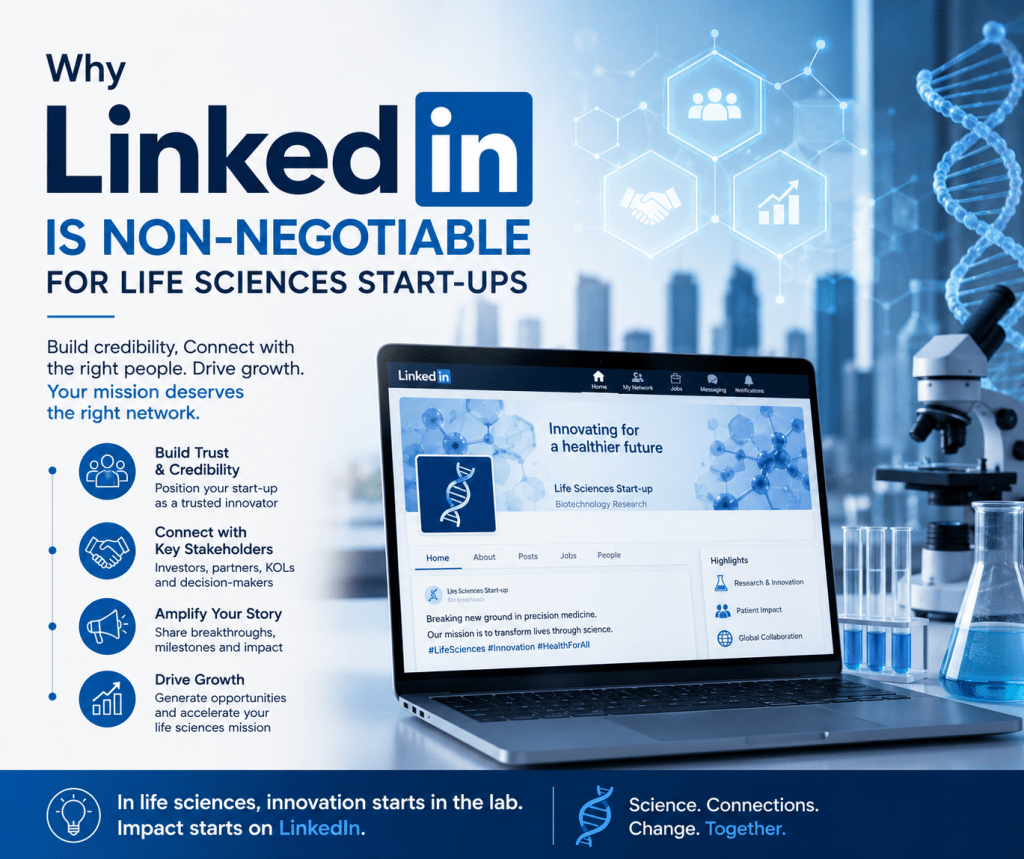
For early-stage biotech and medtech companies spinning out of Newcastle, Durham, Edinburgh or Glasgow, LinkedIn isn’t just another social platform. It’s the room where investors, NHS leads and commercial partners are already talking with or without you.
Most early-stage life sciences founders treat LinkedIn as something to think about later, after the IP is protected, after the funding is in, after the product exists. That’s a mistake with compounding consequences. The investors, NHS innovation leads and commercial partners you need to reach are active on LinkedIn right now. Every week you’re absent from that conversation is a week someone else is occupying the space you should own.
1 – LinkedIn is where your audience actually is
There’s a common misconception in early-stage life sciences that LinkedIn is a recruitment tool useful for hiring, not much else. The reality is starkly different. LinkedIn is now the primary professional content channel for the people who matter most to a pre-Series A biotech or medtech company: early-stage investors, NHS innovation leads, academic collaborators, commercial partners and sector press.
In the North East and Scotland specifically, the life sciences ecosystem has a small-world quality that makes LinkedIn disproportionately valuable. Northstar Ventures, the North East BIC, Edinburgh BioQuarter partners, SNIB investment leads, and the commercialisation teams at Newcastle, Durham, Edinburgh and Glasgow universities are all active on the platform. They’re watching what founders post, how companies position themselves, and which spin-outs appear to have a coherent commercial narrative.
65M+ Decision-makers active on LinkedIn globally
4× More likely to convert B2B buyers via LinkedIn than other social channels
80% Of B2B leads from social media come from LinkedIn
These aren’t abstract statistics. In a sector as relationship-dependent as life sciences, where a warm introduction from a known contact is worth infinitely more than a cold email, LinkedIn is the infrastructure those introductions are built on.
Start-up reality check
Before an investor takes your first meeting, they will look at your LinkedIn company page and your personal profile. If neither tells a coherent story about what you’re building and why it matters, you’ve already lost ground before you’ve said a word.
02 – It’s not a broadcast channel. It’s a credibility infrastructure.
The companies that get LinkedIn wrong treat it as a one-way announcement channel, posting press releases into the void and wondering why nothing happens. The companies that get it right understand something more fundamental: LinkedIn is where your professional reputation is assembled, piece by piece, before anyone has decided whether to take you seriously.
For a spin-out from Newcastle or Edinburgh, that reputation is built from a combination of signals: the quality of your founding team’s individual profiles, the clarity of your company page narrative, the consistency of your content, and the credibility of the people engaging with what you share. A well-executed LinkedIn presence tells investors three things that are very hard to communicate any other way: that your team has domain credibility, that your thinking is commercially coherent, and that your company is active and building momentum.
“LinkedIn isn’t where you make the sale. It’s where you build the trust that makes the sale possible, often months before either party knows a commercial conversation is coming.”
The inverse is equally true. A sparse company page with three followers, an inconsistent posting history, and a founding team whose profiles still describe them as PhD researchers at their parent university sends a clear signal: this company hasn’t yet made the transition from lab to market. That signal reaches investors before you do.
03 – What a life sciences start-up should actually be posting
The question most founders ask is what to post. The better question is what story they’re trying to build over time. LinkedIn content for an early-stage biotech or medtech company should do one of four things: demonstrate scientific credibility, show commercial progress, build founder authority, or expand the network that matters.
In practice, that translates into content that is genuinely specific to your company and your stage not generic “tips” recycled from business influencers, and not impenetrable technical detail lifted from a grant application.
- Milestones with context: regulatory progress, clinical data points, new partnerships always explained in terms of what it means for patients or the market, not just the company.
- Founder perspective pieces: short, direct opinion posts from the CEO or CSO on sector challenges, NHS adoption barriers, or the specific problem your company exists to solve.
- Team and culture signals: hires, PhD completions, collaborations content that signals a credible, growing team rather than a solo founder.
- Ecosystem engagement: commenting thoughtfully on posts from regional accelerators, NHS innovation leads, and sector investors not just broadcasting.
- Evidence posts: peer-reviewed publications, conference presentations, award shortlistings content that builds third-party validation into your LinkedIn narrative.
Common mistake
Posting only about the technology. LinkedIn audiences, particularly investors, need to understand the unmet need, the market size and the commercial path before the platform science becomes compelling context. Lead with the problem. The elegance of your approach follows naturally.
04 – The founder profile matters as much as the company page
One of the most overlooked aspects of LinkedIn strategy for early-stage life sciences companies is the personal profile of the founding team. Investors back people as much as they back technology. In the early stages of a company’s life, before there are significant commercial milestones to point to, the credibility of the founders is often the primary reason an investor takes a meeting.
A founder’s LinkedIn profile should function as a concise, compelling argument for why they are the person to build this specific company. That means a clear headline that describes what you’re building rather than just listing your title, a summary that articulates the problem, the solution and your personal connection to the space, and a track record section that surfaces academic, clinical and commercial achievements in language that a non-specialist investor can evaluate.
It also means being active – not in a performative, post-every-day way, but visibly present and engaged with the sector conversation. Founders who are seen commenting thoughtfully on sector news, engaging with their university commercialisation team’s posts, and occasionally sharing their own perspective build a network and a reputation that pays dividends long before any formal fundraise begins.
🏴 – The Scottish life sciences network on LinkedIn
Scotland’s life sciences community is closely networked, and LinkedIn reflects that. The Scottish Life Sciences Association, Scottish Enterprise, and SNIB all maintain active company pages. Following and engaging with these, alongside University of Edinburgh and Glasgow commercialisation teams, is one of the most direct ways to build visibility with the people and organisations that fund, support and partner with Scottish spin-outs.
🌊 – North East England: a cluster that talks to itself
The North East life sciences ecosystem, from Newcastle University and Durham University through to the North East BIC, Northstar Ventures and the NIHR Newcastle Clinical Research Facility is well connected on LinkedIn. Founders who engage consistently with this community build a regional profile that translates directly into investor introductions, accelerator support and NHS innovation conversations.
05 – LinkedIn as a fundraising tool – used before the raise begins
The most common mistake early-stage life sciences companies make with LinkedIn and fundraising is timing. They ignore the platform for months, then suddenly become very active the week they open a funding round, posting milestones, updating their company page, asking for introductions. By then, the moment has largely passed.
Investor relationships, like all relationships, are built over time. The investor who has seen a thoughtful post from your CEO about NHS adoption barriers, noticed your company page adding followers, and watched a clinical milestone appear in their feed six months ago is a fundamentally warmer conversation than the investor encountering you cold via a pitch deck email.
This is the fundamental argument for treating LinkedIn as an ongoing investment rather than a campaign tool. Consistency over six to twelve months before a raise creates a visible trail of credibility, proof of momentum, intellectual leadership, and team depth, that makes every subsequent investor conversation easier. The raise is the harvest. LinkedIn is the groundwork.
“The raise is the harvest. Everything you post on LinkedIn in the twelve months before it begins is the groundwork. You can’t compress that timeline by posting three times a week in the week you go live.”
06 – Build a strategy, not just a presence
The life sciences sector moves quickly, and the temptation to treat LinkedIn as a box to tick – set up a company page, post occasionally, call it done – is understandable when a founding team is already stretched across R&D, regulatory, clinical and commercial workstreams simultaneously.
But the companies that treat LinkedIn strategically with a clear content narrative, a consistent posting rhythm and a deliberate approach to building the right network consistently outperform those with no strategy. Not because LinkedIn is magic, but because it compounds. A well-executed profile today is worth more than a perfect one launched the week of your Series A.
For spin-outs from Newcastle, Durham, Edinburgh, St Andrews and the wider North East and Scottish cluster, the opportunity is real and underexploited. Many of the most credible technologies in the region remain almost invisible on LinkedIn, leaving the field clear for companies with clearer commercial communications to occupy the investor’s and partner’s attention first. The science alone will not do the work. It needs a voice and right now, LinkedIn is where that voice carries furthest.
Ready to build your LinkedIn strategy?
Read Marketing works with biotech, medtech and medical device start-ups across the North East and Scotland to develop marketing strategies that match the stage and ambition of your business.
 read-marketing.com
Leave a comment